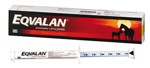
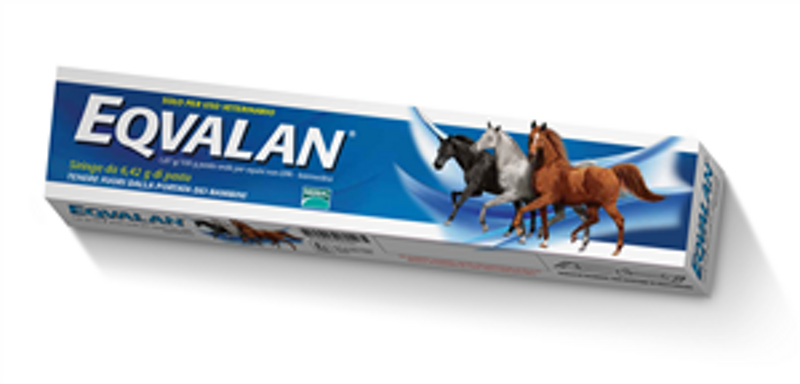
EQVALAN ® oral paste for non-food-producing equines is indicated for the treatment and control of internal parasites of equines of all ages. Gastrointestinal nematodes—Larval stages with endoarterial localization of Strongylus vulgaris, larval stages with tissue localization of S. edentatus, L4 of Triodontophorus spp.; adults of S. vulgaris, S. equinus, S. edentatus, Triodontophorus spp.,T. brevicauda, T. serratus, T. tenuicollis, Craterostomum acuticaudatum; adults and immature stages of small strongyles, including benzimidazole-resistant strains (Coronocyclus spp., Cyathostomum spp., Cylicocyclus spp., Cylicodontophorus spp., Cylicostephanus spp., Gyalocephalus spp.); adults of Coronocyclus coronatus, C.labiatus, C. labratus, Cyathostomum catinatum, C. pateratum, Cylicocyclus ashworthi, C. elongatus,C. insigne, C. leptostomum, C. nassatus, C. radiatus, Cylicodontophorus bicoronatus, Cylicostephanus asymetricus, C. bidentatus, C. calicatus, C. goldi, C. longibursatus, C. minutus, Gyalocephalus capitatus, Parapoteriostomum spp., P. euproctus, P. mettami, Petrovinema spp., P. poculatum, Poteriostomum spp.,P. imparidentatum, P. ratzii. Adults and L4 of Oxyuris equi; adults, L3 and L4 of Parascaris equorum; adults of Trichostrongylus axei and Habronema muscae; adults of Strongyloides westeri; L4 of Habronema spp.; - Adults and immature stages of Dictyocaulus arnfieldi.Microfilariae of Onchocerca spp. Bots: oral and gastric stages of Gasterophilus spp., L2 and L3 of G. intestinalis.Dermatoses caused by cutaneous larvae of Habronema spp. and Draschia spp. (summer sores) and by microfilariae of Onchocerca spp. (cutaneous onchocerciasis).
Dosage:
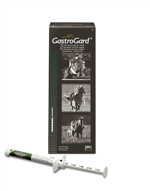
Oral route Horses: 200 µg/kg b.w. One syringe contains enough paste to treat orally a 600 kg horse at the recommended dose of 200 µg of active ingredient/kg b.w. Each mark on the graduated plunger of the syringe corresponds to the amount of paste sufficient for the treatment of 100 kg of body weight. • Recommended parasite control program: all horses in the breeding farm/stable should be included in a systematic parasite control program, with particular attention to mares and foals. Foals should be treated for the first time between 6 and 8 weeks of age and the treatment should be repeated at regular intervals. Systemic treatment reduces the likelihood of colic and arthritis caused by the larval forms ofS. vulgaris.














.webp "formalife-plus")




.png "gastrik-pet")




.webp "smigol-barattolo-1kg")